
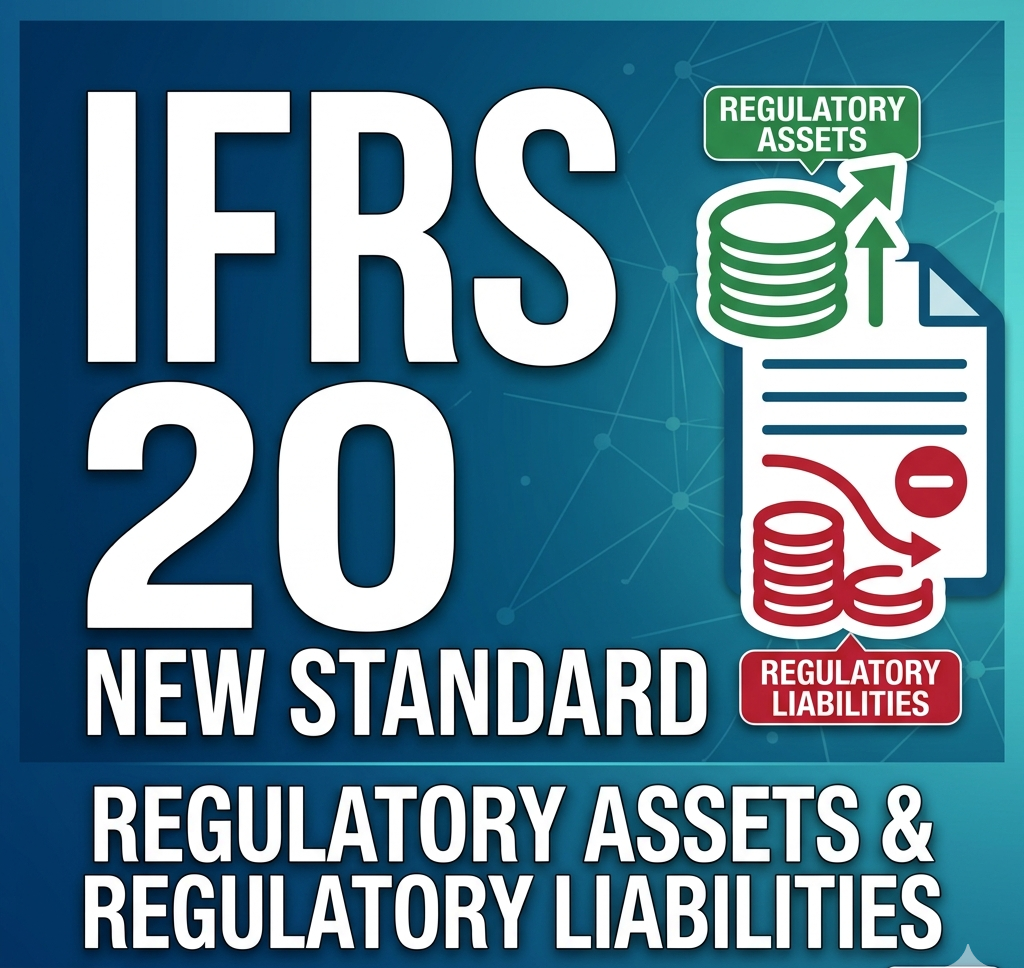
The standard IFRS 20: Regulatory Assets and Regulatory Liabilities, newly finalized by the International Accounting Standards Board (IASB), marks a historic shift for companies operating in rate-regulated industries like banks, public transport, telecom, energy etc. Its core meaning focuses on standardizing how businesses account for timing differences created by regulators. In sectors like power, water, and gas, a regulator may permit a company to recover specific expenses or require it to return excess earnings by adjusting future customer tariffs. Historically, standard accounting ignored these future rate adjustments until they materialized. IFRS 20 bridges this gap by identifying these enforceable rights and obligations as true financial items, reflecting total earned compensation during the precise period goods or services are delivered rather than when the cash eventually flows.
The Strategic Framework of IFRS 20
Adoption
The standard is slated for mandatory adoption for annual reporting periods beginning on or after January 1, 2029 (though bodies like EFRAG – European Financial Reporting Advisory Group have noted calls to push this to 2030 for highly complex cross-border structures). It universally targets any entity operating under a regulatory agreement that binds both the company and a regulator to future price adjustments.
Recognition
Under recognition rules, a firm must record a regulatory asset when it holds an enforceable present right to add an amount to future rates because it under-recovered its allowed cost or margin in the current period. Conversely, a regulatory liability must be recognized when the entity faces an enforceable present obligation to deduct an amount from future rates due to over-recovery. If uncertainty exists regarding the rule’s validity, a threshold of “more likely than not” dictates whether the asset or liability is recognized.
Example: A gas utility company experiences an unforeseen 50% spike in wholesale fuel procurement costs in Year 1. Under the regulatory agreement, the utility must absorb the cost initially but is legally guaranteed to recover that expenditure via a price hike on consumers in Year 2. Under strict historical IFRS, Year 1 profits would drop artificially due to the unmitigated cost. Under IFRS 20, the utility recognizes a regulatory asset alongside regulatory income in Year 1, keeping financial performance aligned with economic reality.
Measurement and Disclosure
For measurement, IFRS 20 mandates a uniform cash-flow-based technique. At initial measurement, an entity models all future cash flows expected to result from the asset or liability, discounting them to present value using the specified regulatory interest rate. For subsequent measurement, these cash flow predictions are continuously reassessed and updated, while the initial regulatory discount rate remains constant unless altered directly by the regulator.
The disclosure requirements are designed to eliminate traditional “black box” regulatory tracking. Entities must present regulatory income or expenses as completely separate line items in the statement of profit or loss, and do the same for assets and liabilities on the balance sheet. Accompanying notes must clearly explain the nature of the regulatory agreements, the specific risks involved, and how these balances will impact the timing and volatility of future cash flows.
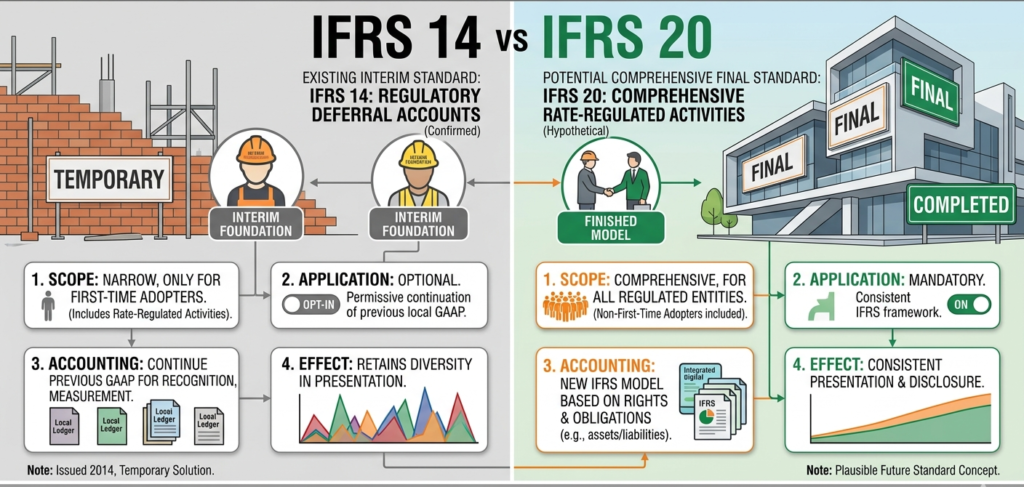
Paradigm Shifts: Moving From IFRS 14 to IFRS 20
The introduction of IFRS 20 signals the formal retirement of IFRS 14: Regulatory Deferral Accounts. The differences between these two frameworks highlight the evolution of global accounting harmonization:
The Cross-Industry Ripple Effect: Impact on Bangladeshi Banks
While IFRS 20 explicitly targets rate-regulated companies like utility providers and infrastructure operators, its implementation will trigger severe indirect macroeconomic consequences for the Bangladeshi banking sector. Bangladeshi commercial banks maintain heavily exposed credit portfolios heavily concentrated in national infrastructure and large-scale public-private partnerships (PPPs) regulated by entities like the Bangladesh Energy Regulatory Commission (BERC).
Credit Assessment and Risk Management
When local energy and infrastructure conglomerates adjust their balance sheets to comply with IFRS 20, their leverage, equity structures, and current ratios will experience sudden shifts. If a Bangladeshi power generation client has accumulated massive unrecognized deferred expenses, recognizing them as “regulatory assets” under IFRS 20 will instantly expand their balance sheet size and improve initial debt-to-equity ratios.
However, Bangladeshi risk officers will need to rigorously assess these newly visible assets. Because a regulatory asset relies on a utility’s capacity to squeeze cash out of future consumer tariffs, banks must evaluate sovereign and macroeconomic risks. If local inflation spikes or the government institutes a popular price freeze, those regulatory assets risk becoming impaired. Banks will have to adjust their credit risk models to differentiate between hard, liquid collateral and deferred regulatory promises.
Asset-Liability Matching and ESG Financing
Furthermore, the cash-flow-based measurement under IFRS 20 gives local banks a highly transparent, discounted timeline showing exactly when their corporate borrowers expect to recoup their capital. This allows financial institutions to design far more accurate debt service coverage ratios (DSCR) and align loan maturity schedules with regulated cash recoveries. As Bangladesh moves aggressively to expand its green energy and infrastructure sectors through syndication loans, the implementation of IFRS 20 will give commercial banks the standardized financial data needed to safely structure long-term project finance and attract foreign direct investment.


Hossain