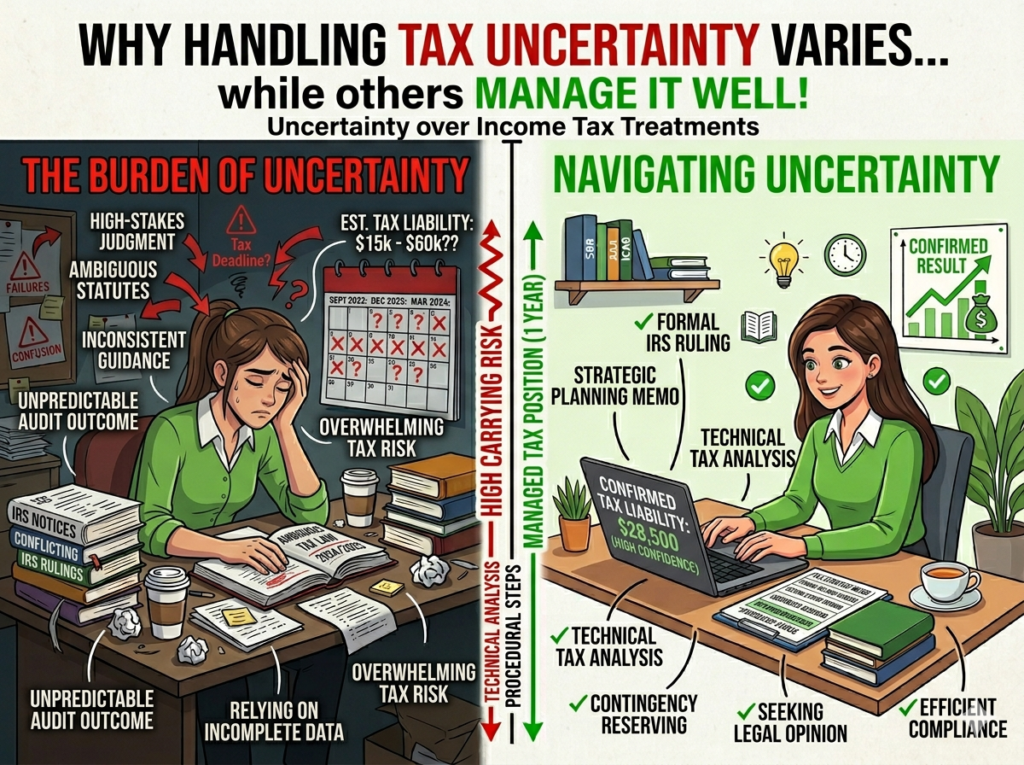
Income tax is often one of the most judgment-driven areas of financial reporting. While IAS 12 sets out the principles for recognizing and measuring current and deferred tax, real-world situations frequently involve uncertainty — for example:
Will the tax authority accept a particular deduction? Is a transfer pricing adjustment likely? How should pending litigation be reflected in tax reporting?
This is where IFRIC 23: Uncertainty over Income Tax Treatments becomes critical. What does IFRIC 23 require?
The Interpretation clarifies how to account for uncertain tax positions when it is unclear whether the relevant tax authority will accept the company’s chosen tax treatment. It requires management to: Determine whether tax treatments are assessed individually or collectively.
Assume that the tax authority will examine amounts in full and has all relevant information. Use either the ‘most likely amount’ or the ‘expected value’ method to measure uncertainty. Reassess judgments when facts or circumstances change. Why is this important?
It promotes consistency in how companies deal with uncertainty in income tax. It enhances comparability across entities and jurisdictions. It reduces the risk of “surprise” adjustments later when disputes are resolved.
Lets see A practical example Imagine a company claiming a $5m R&D deduction. Legal advisors believe there’s a 60% chance the tax authority will accept it, but a 40% chance only $2m will be allowed.
Under IFRIC 23, management must consider whether to use the expected value (weighted average outcome) or the most likely amount (depending on which better predicts the resolution).
Key takeaway: IFRIC 23 is not about predicting tax authority behavior with certainty. It is about applying structured, transparent, and consistent judgments under uncertainty — thereby strengthening the credibility of financial statements.
As global tax environments become more complex, applying IFRIC 23 rigorously is not just compliance — it’s a signal of sound governance and robust risk management