
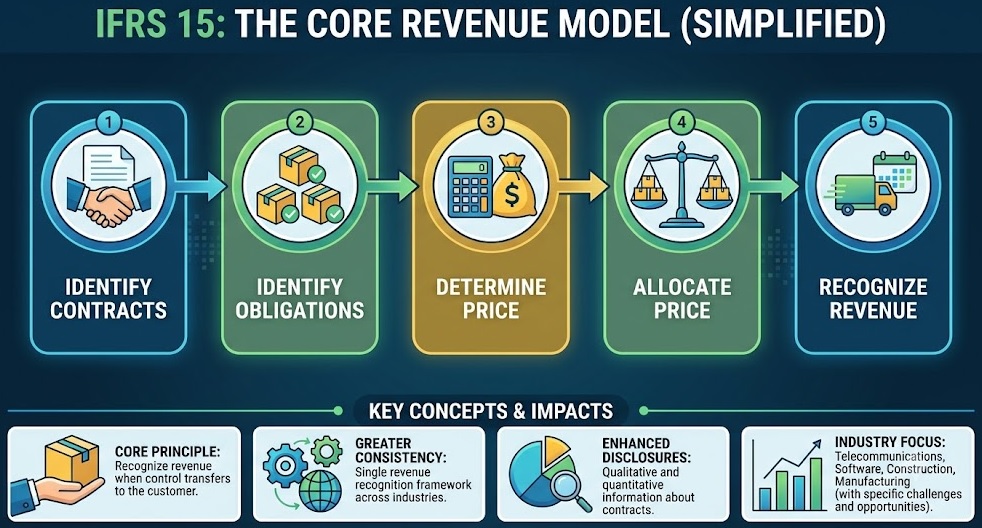
Revenue is often mistaken for the most straightforward number on the financial statements. In reality? It’s a battlefield of intense professional judgment.
By replacing the old IAS 11 and IAS 18 standards, IFRS 15 (Revenue from Contracts with Customers) introduced a unified, principles-based framework. But while its famous five-step model sounds simple on paper, applying it to real-world commercial deals is a high-stakes puzzle.
Here are the 10 trickiest areas where accounting professionals frequently trip up—and how to navigate them with sharp professional skepticism.
1. The “Ink on Paper” Illusion
The Myth: A signed contract equals instant revenue recognition. The Reality: Not so fast.
An enforceable contract is just the entry ticket. Under IFRS 15, you cannot recognize revenue unless collection is probable. If a customer’s ability or intent to pay is shrouded in uncertainty, that revenue must stay off the books—regardless of how official the contract looks.
2. The Bundling Trap: Identifying Performance Obligations
Determining whether promised goods or services are “distinct” is one of the standard’s steepest hurdles. Products and services that seem separate on the surface often blend into a single performance obligation if they are highly integrated or heavily customized. This is a constant tightrope walk in the technology, engineering, and construction sectors.
3. The Control Paradigm Shift
If you are still thinking in terms of “risks and rewards,” you are accounting in the past. IFRS 15 completely flipped the script to a control-based model. Revenue triggers only when the customer gains control of the asset—either over time or at a distinct point in time. This single shift fundamentally reshaped financials across manufacturing, software, and telecom.
4. Variable Consideration: The Optimism Filter
Bonuses, rebates, performance incentives, and volume discounts make revenue a moving target. While IFRS 15 requires you to estimate these amounts, it forces you to use a conservative lens: you can only include variable consideration in the transaction price if it is highly probable that a massive revenue reversal won’t happen later.
5. Principal vs. Agent: Gross vs. Net Headlines
Are you the main act or just the middleman?
- Principal: You control the asset before it hits the customer. You record revenue on a gross basis.
- Agent: You merely facilitate the deal. You only record your commission or fee.
Getting this wrong doesn’t just mess up the presentation; it artificially inflates (or deflates) a company’s top-line growth and operating scale.
┌────────────────── Principal vs. Agent ──────────────────┐
│ │
▼ ▼
Principal Agent
(Controls asset first) (Facilitates deal)
│ │
▼ ▼
Gross Revenue Net Commission
6. Contract Modifications: Fresh Start or Continuity?
Commercial deals are living organisms; scopes, prices, and deliverables change constantly. Every time a contract is modified, you must pause and assess: Is this a brand-new standalone contract? A termination of the old one and the birth of a new one? Or simply a cumulative catch-up adjustment? The answer hinges entirely on the pricing and nature of the new deliverables.
7. Warranties: Protection vs. Promotion
Warranties do not automatically default to standard provisions. IFRS 15 splits them into two distinct categories:
- Assurance Warranties: A guarantee that the product works as promised (accounted for under IAS 37).
- Service Warranties: An extra, look-forward service sold to the customer. This counts as a separate performance obligation, requiring you to defer a slice of the transaction price.
8. The Capitalization Pivot
In the past, sales commissions and bid costs were buried immediately in operating expenses. IFRS 15 changed the game. Incremental costs incurred solely to secure a contract must now be capitalized as assets on the balance sheet, provided the company expects to recover them.
9. Loyalty Programmes & The “Material Right”
Points, cash-back rewards, and promotional credits aren’t just marketing gimmicks—they are material rights given to customers. Under the standard, you must mathematically carve out a portion of the initial purchase price, allocate it to those future loyalty points, and hold it back until the customer actually redeems them (or they expire).
10. Disclosures: Transparency is the New Metric
You cannot hide behind accurate math anymore. IFRS 15 demands unprecedented disclosure. Entities must openly explain management’s key judgments, contract balances, remaining performance obligations, and the exact timing of revenue streams. It’s no longer just about the what, but the how and why.
Final Thoughts
The real test of IFRS 15 isn’t memorizing the five steps; it’s surviving the collision between those steps and increasingly complex, modern business models. Subscriptions, bundled tech stack solutions, dynamic pricing, and evolving contract structures require more than just technical knowledge. They require rock-solid professional judgment.
Mastering these 10 areas is exactly how forward-thinking financial professionals transform compliance into high-quality, transparent reporting that stakeholders can actually trust.


Bài viết hay, mình học được nhiều điều. Letco là địa chỉ du học Hàn Quốc đáng tin cậy, hỗ trợ toàn diện từ tiếng Hàn đến visa. Xem tại letco.vn.