

Lease Modifications
Lease modifications are one of the more operationally demanding areas of IFRS 16, precisely because they show up constantly in practice. Landlords and tenants renegotiate terms all the time — a company gives back a floor it no longer needs, extends a warehouse lease to avoid relocation costs, or takes on an extra vehicle mid-contract. Each of these triggers a different accounting outcome, and getting the classification wrong flows straight through to the balance sheet and P&L.
This guide walks through the mechanics of accounting for lease modifications under IFRS 16, with the judgement points finance teams need to apply and worked examples that mirror what you’ll see in an actual set of lease accounting workpapers.
What counts as a lease modification
Per IFRS 16, a lease modification is a change in the scope of a lease, or the consideration for a lease, that was not part of the original terms and conditions — agreed between the lessor and lessee. Common triggers include:
- Extending or shortening the lease term
- Returning part of the leased asset (e.g., handing back a floor of office space)
- Adding space, equipment, or additional assets to the contract
- Renegotiating the rent, whether up or down
It’s worth drawing a clear line here: a modification is a negotiated change to the contract. It is distinct from a reassessment, which is triggered by the mechanics already built into the original lease — for example, a lessee reassessing whether it’s reasonably certain to exercise an extension option, or a liability being remeasured because of an index or rate change (such as a CPI-linked rent review). Reassessments are covered separately under IFRS 16 and follow their own remeasurement logic; this article focuses specifically on negotiated modifications.
Step 1: Is the modification a separate lease?
The first test is whether the modification should be accounted for as an entirely new, separate lease, leaving the original lease untouched.
A modification is accounted for as a separate lease when both of the following are true:
- The modification grants the lessee the right to use one or more additional assets not covered by the original contract, and
- The additional consideration is commensurate with the standalone price for that additional right of use — adjusted for the circumstances of the contract (e.g., a discount for having an existing relationship with the lessor).
Example — separate lease
A retail chain leases five floors of a commercial building. Midway through the lease, it agrees to rent a sixth floor at the landlord’s normal market rate for that space in that building.
- Additional asset: yes, a new floor
- Priced at standalone rate: yes
Both conditions are met, so this is treated as a new, separate lease. It is recognised on its own — new right-of-use (ROU) asset and lease liability, measured at the present value of the incremental payments — and the original five-floor lease continues to be accounted for exactly as before.
Where the pricing is not commensurate with the standalone rate (a bundled discount, for instance), the “separate lease” test fails even though an asset has been added, and the change is accounted for under the general modification rules below.
Step 2: If not a separate lease, does the scope decrease?
Most modifications fail the separate-lease test (either there’s no new asset, or the pricing isn’t standalone). For these, the next question is whether the modification decreases the scope of the lease.
A. Scope decreases (partial termination)
This covers situations such as:
- Giving back part of a leased building or site
- Returning one or more assets out of a fleet (e.g., 2 of 10 leased vehicles)
- Shortening the remaining lease term
Accounting treatment:
- Decrease the carrying amount of the ROU asset to reflect the partial or full termination, generally on a proportionate basis reflecting the reduction in scope.
- Remeasure the lease liability using a revised discount rate, reflecting the reduced payments.
- Recognise the difference between the reduction in the lease liability and the proportionate reduction in the ROU asset as a gain or loss in profit or loss at the effective date of the modification.
Worked example
A logistics company leases a distribution centre. Immediately before a modification:
| Item | Amount |
|---|---|
| Lease liability | BDT 500,000 |
| ROU asset (carrying amount) | BDT 400,000 |
The company agrees to hand back 20% of the warehouse floor space. As a result, the lease liability is remeasured and falls by BDT 100,000.
Step 1 — reduce the ROU asset proportionately: BDT 400,000 × 20% = BDT 80,000 reduction
Step 2 — compare to the liability reduction: BDT 100,000 (liability decrease) − BDT80,000 (ROU decrease) = BDT 20,000 gain
Journal entry:
Dr Lease liability                 100,000
    Cr Right-of-use asset                    80,000
    Cr Gain on lease modification (P&L)      20,000
The intuition: the liability came down by more than the proportionate value of the asset given up, so the excess is recognised as a gain. If the liability reduction had been smaller than the proportionate ROU write-down, the balancing entry would be a loss instead.
B. Scope does not decrease
This covers modifications where the lessee retains full use of the original asset(s), such as:
- A straightforward rent increase or decrease
- An extension of the lease term
- Other changes that don’t reduce the lessee’s right of use
Accounting treatment:
- Remeasure the lease liability at the present value of the revised payments, using a revised discount rate.
- Recognise the corresponding adjustment against the ROU asset — there is generally no gain or loss recognised in P&L for this type of modification.
Journal logic:
If the remeasurement increases the liability (e.g., a rent increase or term extension):
Dr Right-of-use asset
    Cr Lease liability
If the remeasurement decreases the liability (e.g., a negotiated rent reduction with no change in scope):
Dr Lease liability
    Cr Right-of-use asset
Step 3: The discount rate always gets revisited
Whenever a modification is not accounted for as a separate lease, the lease liability is remeasured using a revised discount rate determined at the effective date of the modification. In practice, this is:
- The interest rate implicit in the lease, if it can be readily determined, or
- The lessee’s incremental borrowing rate at the modification date, if not.
This matters operationally: even a modification that looks administratively minor (say, a small rent adjustment) requires treasury or finance to source a current borrowing rate for the remeasurement — not the rate used at lease commencement.
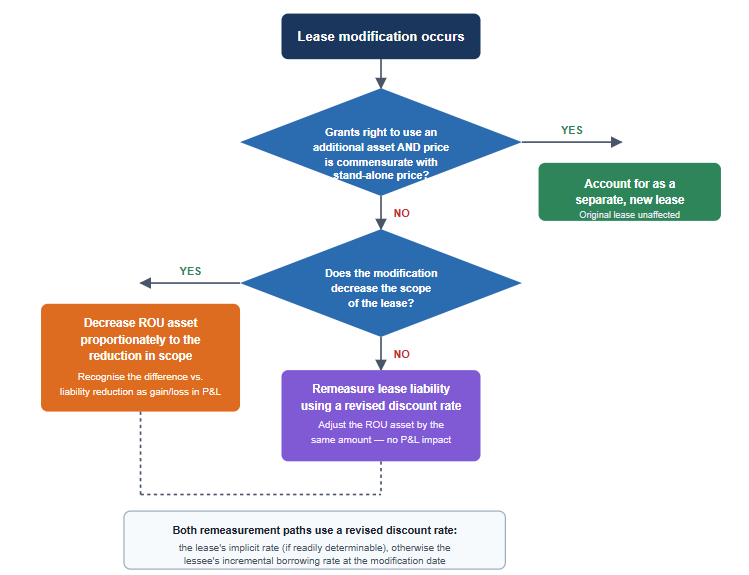
Putting it together: the decision flow
The image below summarises the full assessment process finance teams should apply whenever a lease modification is negotiated.
Quick-reference summary
| Situation | Accounting treatment |
|---|---|
| Additional asset + standalone price | Account for as a separate, new lease |
| Additional asset, but not priced at standalone rate | Not a separate lease — apply general modification rules |
| Scope decreases | Reduce ROU asset and liability proportionately; gain/loss to P&L |
| Scope does not decrease | Remeasure liability; adjust ROU asset; generally no P&L impact |
| Any non-separate-lease modification | Use a revised discount rate for remeasurement |
A practical note for finance teams
The most common error in practice isn’t misapplying the journal entries — it’s misclassifying the trigger in the first place. Two situations worth flagging for your review process:
- Bundled pricing on “additional asset” modifications. If a landlord offers an extra unit at a discounted or blended rate rather than its standalone price, don’t default to separate-lease treatment just because a new asset is involved — check the pricing test carefully.
- Partial terminations buried in broader renegotiations. When a lease renegotiation combines a scope reduction (e.g., giving back space) with other changes (e.g., extending the remaining term), the scope-decrease treatment still applies to the portion given back, and the accounting can require careful unbundling before the liability is remeasured as a whole.
Getting the initial classification right is what determines whether you’re looking at a new lease on the books, a P&L gain or loss, or a quiet remeasurement that only moves the balance sheet.


If TDS % extra borne by the lessee. Lessor is not ready to pay. Then will it be considered modification?