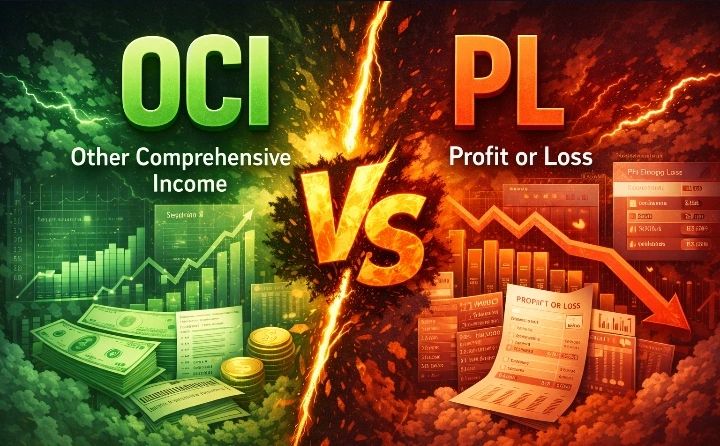
Profit or Loss (P/L) serves as the primary record for performance, while Other Comprehensive Income (OCI) is strictly reserved for “exceptions”—items that affect equity but are not part of day-to-day results.
A frequent misconception is that all unrealized gains and losses belong in OCI; however, OCI only captures specific items mandated by international standards. These include revaluation surpluses for property, plant, and equipment (IAS 16) or intangibles (IAS 38), and remeasurements of defined benefit plans, such as actuarial gains.
Additionally, OCI houses the effective portion of cash flow hedges and foreign currency translation differences arising from the consolidation of foreign subsidiaries. Under IFRS 9, companies may also designate certain financial instruments at Fair Value Through Other Comprehensive Income (FVOCI). A critical nuance is reclassification (recycling): while gains from FVOCI debt instruments are eventually moved to P/L upon disposal, other items, such as actuarial gains on pensions, are never recycled.
In contrast, the Profit or Loss statement captures a wide array of both realized and unrealized outcomes deemed essential for evaluating immediate financial health. Fair value changes for assets classified as Fair Value Through Profit or Loss (FVTPL), such as trading securities or derivatives not used for hedging, must be reported in P/L. This requirement extends to investment property under the fair value model (IAS 40) and biological assets (IAS 41), where all valuation swings flow directly through the performance statement. Furthermore, while OCI handles subsidiary translation, foreign exchange changes on individual monetary items, such as loans or payables, are recognized in P/L. Impairment losses, inventory write-downs, and provisions for legal or restructuring costs are strictly P/L items. Even if an asset has a revaluation surplus in OCI, any impairment exceeding that surplus must hit P/L. Finally, regardless of an asset’s classification, interest income, dividend income, and the final gain or loss on disposal are always recognized in P/L, ensuring a transparent record of realized economic outcomes.
To conceptualize this, think of Profit or Loss as a professional athlete’s game stats, recording every point scored and foul committed during the match, while Other Comprehensive Income is like the fluctuating market value of the athlete’s contract—it significantly impacts their wealth (equity), but it doesn’t change the score of the game being played today.